Last Updated: June 2026
ISO 9001:2015 Certified, Hand-Assembled Wire Harness Manufacturing for OEMs. Dedicated production facility in Pune. 4 decades of cable and wire manufacturing experience.
On the production floor, a wire harness can look deceptive — just a bundle of copper, connectors, and protection sleeves. The moment it gets routed into a vehicle sub-system or an industrial control panel, it starts carrying the product's entire electrical reliability on its back. A single crimp with weak pull-strength, or a terminal that shifts slightly during transit, and an entire batch can face rejection on the customer's assembly line. As a wire harness manufacturer in Pune, we run our Ranjangaon MIDC facility around exactly this kind of risk — wiring-diagram-led production, not guesswork.
We work only with OEMs — appliance brands, industrial equipment makers, medical device companies, and automotive and EV component manufacturers — not single-piece or retail buyers. Some of these buyers call us a wire harness manufacturing company in India; others use the term cable harness manufacturer. At Ni-San Cords both terms point to the same team, the same Ranjangaon facility, and the same wiring-diagram-led process.
Engineering teams comparing the best wire harness manufacturers in India usually find that quality drift is hard to spot from the outside. A sample on the evaluation desk always looks correct — the real test is whether the ten-thousandth unit off the line still matches it. That is the discipline we build around: crimping consistency, terminal seating, and routing checks that hold up across the full production run, not just the first batch.
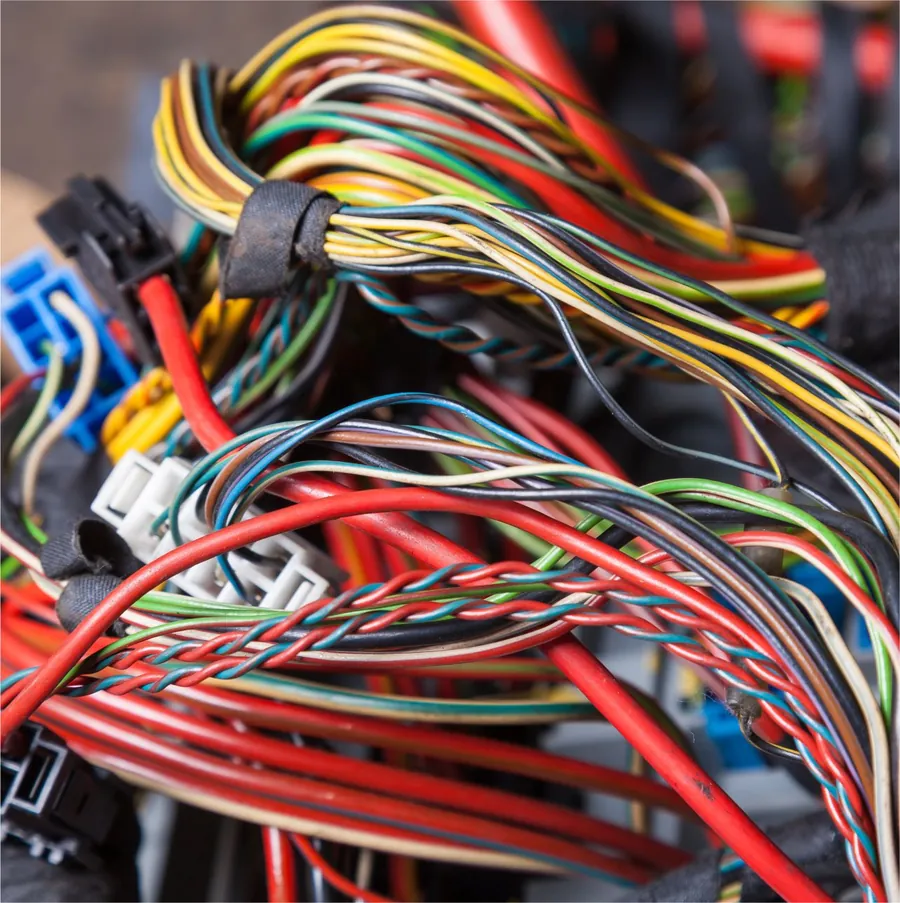
India's automotive wiring harness market was valued at close to USD 1.9 billion in 2025 and continues to grow as vehicle electronics content rises, EV adoption increases, and appliance, industrial, and medical equipment manufacturers add more wiring-dependent features to their products.
An approved prototype only proves the first unit works — production has to prove the next ten thousand do too.
For OEM buyers, the real risk is not always one visibly defective harness. The bigger risk is a single miswired circuit, a loose crimp, or a swapped connector position buried inside a bundle that looks correct from the outside. A wire harness can pass a quick visual check and still fail continuity once it reaches the assembly line.
Quality drift on the shop floor rarely shows up as one obviously bad harness. It shows up as a half-millimetre shift in crimp height between the morning and night shift, or a colour-coding mix-up on a low-priority circuit that a quick scan misses. The harness still looks like the approved sample — it just stops behaving like it once it's wired into your product.
We work with OEMs that need wiring-diagram-led manufacturing, not generic harness supply. Every bulk requirement is built around the final product application, circuit count, wire gauge, connector type, routing path, insulation need, and testing expectation defined before assembly begins.
| OEM Team | What They Need | How Ni-San Supports It |
|---|---|---|
| Purchase Team | Competitive pricing, timely delivery, repeat supply | Bulk manufacturing, customer orientation, delivery discipline |
| Quality Team | ISO-controlled processes, continuity testing, documentation | ISO 9001:2015 QMS, in-process and final inspection support |
| Production Team | Connector fitment consistency, correct routing, stable harness quality | Wiring-diagram-based production and batch consistency |
| R&D / Engineering | Application-specific design, prototypes, connector and wire selection | Custom wire harnesses manufactured to customer wiring diagrams |
| After-Sales Team | Lower risk of field complaints and rework | Crimp discipline, routing checks, electrical verification |
ISO 9001:2015 certification recognizes that we have implemented defined processes, resources, monitoring systems, inspection methods, and working practices that support customer satisfaction and organizational efficiency.
For wire harness production, the QMS covers how a wiring diagram is interpreted, how wire and connector inputs are controlled, how crimping and bundling are monitored, and how non-conformities are handled before dispatch.
Crimping multiple terminals, taping at breakout points, binding loose wires into a fixed shape, and routing through sleeves or conduit are complex tasks. We rely on skilled manual assembly for these steps rather than forcing them through rigid automation.
Manual assembly is especially valuable for small and mid-sized OEM batches where wiring diagrams change frequently between orders, and where automated tooling would add cost without adding reliability.
Every harness batch goes through continuity testing across each circuit, visual and dimensional inspection, and a connector fitment check before it is packed for dispatch.
For OEM customers, this reduces the chance of a wiring fault reaching the buyer's assembly line. Our team can walk customers through these checks as part of the vendor approval process.
| Check Area | What It Verifies | Why OEMs Should Care |
|---|---|---|
| Continuity Testing | Every wire and circuit connects correctly end to end | Confirms the harness is electrically functional before it reaches assembly |
| Crimp & Termination Check | Crimp height, pull strength, and terminal seating | A weak crimp is one of the most common causes of intermittent failure |
| Connector Fitment | Correct connector type, pin position, and mating force | Prevents mismatched connectors from delaying OEM assembly lines |
| Visual & Dimensional | Harness length, branch positions, label and colour coding | Confirms the harness matches the approved drawing, not just the sample's look |
We use controlled-quality copper conductors along with insulation, sleeving, and connector inputs selected for the target application. Wire harness reliability begins before crimping, bundling, or testing. It begins with the wire, the terminal, and the connector housing.
For OEMs, a cheaper wire or an off-spec connector can become expensive later. A harness that costs slightly less at purchase may lead to intermittent connections, field complaints, rework on the assembly line, or warranty pressure once the product is in the buyer's hands.
A single loose connection inside a washing machine, refrigerator, water heater, air conditioner, medical device, UPS, or vehicle sub-system can disable the entire circuit it sits in.
| Material Factor | Why It Matters |
|---|---|
| Copper Conductor Quality | Supports safe current flow and reliable signal transmission |
| Insulation & Sleeving Material | Affects abrasion resistance, flexibility, and heat behaviour |
| Connector & Terminal Quality | Influences mating force, contact reliability, and durability |
| Crimp & Termination Method | Determines long-term contact resistance and pull strength |
| Routing & Protection Material | Protects bundled wires from vibration, moisture, and chafing |
Every application places different demands on a wire harness — a washing machine harness is not wired the same way as a medical equipment harness. A vehicle harness is not built the same way as a control panel harness.
 Water Heaters
 Washing Machines
 Refrigerators
 Air Conditioners
 Televisions
 Medical Equipment
 UPS Systems
 Power Tools
 Gardening Equipment
 EVs
EVs Vehicles
We manufacture appliance wiring harnesses, industrial and control panel harnesses, automotive and EV wiring harnesses, medical equipment harnesses, custom multi-pin connector harnesses, and power distribution harnesses. The final construction depends on the circuit count, wire gauge, connector type, routing path, and target application.
Ni-San builds appliance wire harnesses for washing machines, water heaters, refrigerators, and air conditioners — wiring sized and routed to match each appliance's enclosure.
Multi-circuit harnesses for control panels, switchgear, and industrial machinery wiring make up the bulk of what an industrial wire harness manufacturer like Ni-San produces.
Vehicle sub-systems and EV components need wiring that survives vibration and heat — this is where Ni-San works as an automotive wire harness manufacturer in India, building to the buyer's circuit drawing.
Precision-wired harnesses for medical devices where reliable, repeatable connectivity is essential.
Harnesses built around the customer's specific connector, pin-out, and mating requirement.
Internal wiring harnesses that distribute power between sub-assemblies inside the final product.
Send us your wiring diagram or a physical sample. Our engineering team at Ranjangaon will check terminal specs and routing, then build a prototype you can test-fit before freezing the design for bulk production.
Submit an EnquiryNot every OEM requirement fits into a standard harness format. Some products need a specific circuit count, connector type, branch length, routing path, sleeving material, colour coding scheme, or application-specific performance requirement.
Prototype-based development reduces guesswork. The buyer can physically test the harness with the product, confirm connector mating, check routing and bend behaviour, verify every circuit, and finalize the construction before moving to larger quantities.
OEM shares product type, circuit need, connector type, length, and quantity. Prevents wrong harness selection at the outset.
Wire gauge, connector positions, branch points, sleeving, and colour coding are discussed. Aligns technical and commercial expectations.
Sample harness is hand-assembled for review. Allows fitment, routing, and handling checks before committing to bulk.
OEM tests the harness with the product or assembly process. Reduces risk before bulk production.
Approved prototype becomes the production reference. Supports repeatable manufacturing across batches.
Bulk manufacturing needs a process that protects the approved wiring diagram. The harness should not change from prototype to production unless the buyer approves the change.
| # | Process Step | What Ni-San Controls |
|---|---|---|
| 1 | Requirement Review | Application, quantity, circuit count, connector type, wire gauge, target market |
| 2 | Wiring Diagram Freezing | Branch lengths, connector positions, colour coding, sleeving, compliance need |
| 3 | Prototype / Sample | Fitment, routing, connector mating, handling, assembly suitability |
| 4 | Raw Material Control | Copper wire, insulation, sleeving, connector and terminal components |
| 5 | Cutting, Stripping & Crimping | Wire length, strip length, crimp height, terminal seating |
| 6 | Bundling & Routing | Taping, sleeving, conduit insertion, branch positioning |
| 7 | Testing & Dispatch | Continuity check, visual and dimensional inspection, packed supply for OEM assembly |
A purchase description such as “six-way harness” is rarely enough for repeat OEM production. Two assemblies can have the same circuit count and still differ in current carrying requirement, wire size, connector family, branch geometry, protection and final fitment. The safest starting point is a controlled drawing, approved sample or clearly documented specification that both the buyer and manufacturer can refer to.
For procurement teams, this also makes quotation comparison more meaningful. When every shortlisted cable harness supplier is working from the same technical reference, differences in price, tooling, sample approval and production terms are easier to evaluate without silently changing the construction.
| Requirement to Freeze | What the Buyer Should Define | Why It Matters in Bulk Production |
|---|---|---|
| Circuit & Pinout | Number of circuits, pin positions, polarity and connection map | Prevents a visually correct harness from being electrically incorrect |
| Wire | Wire type, conductor area or gauge, insulation, colour and applicable specification | Links the assembly to the intended electrical and routing requirement |
| Terminals & Connectors | Part references, mating connector, keying and terminal positions | Supports correct fitment on the customer's assembly line |
| Geometry | Overall length, branch lengths, breakout points and tolerances | Helps the harness route through the product without tension or excess slack |
| Protection | Sleeving, conduit, tape, heat-shrink and protected areas | Defines how the bundle is managed in the intended environment |
| Identification | Labels, markers, colour codes and orientation references | Reduces assembly errors and supports repeat production handling |
| Inspection | Drawing checks, continuity requirement, fitment checks and customer-specific acceptance points | Creates a clear basis for sample and batch approval |
| Commercial Supply | Expected quantity, batch size, packing and dispatch requirement | Lets the manufacturing and packing plan reflect the actual B2B requirement |
Ni-San supports wire harness assembly services for bulk OEM requirements where the construction can be defined against an approved technical reference. The work may begin from a wiring diagram, customer specification or physical sample, depending on the requirement and what can be reliably reproduced.
The practical value of an assembly partner is consistency after the prototype has been accepted. Cutting and stripping, crimping, terminal insertion, connector fitment, bundling, sleeving, routing and identification all have to keep following the same reference when production moves into repeat batches. A change that appears minor on the bench can create fitment or electrical problems once thousands of assemblies are moving through an OEM line.
This is why a custom wire harness manufacturer should treat the approved sample or drawing as a production control document, not merely as a quotation aid. If a component, route or construction detail needs to change, the change should be reviewed rather than allowed to drift silently into production.
Buyers use the terms wire harness, wiring harness, cable harness and cable assembly differently across industries. For sourcing, the label matters less than the construction. The manufacturer needs enough information to identify the electrical paths, wires, terminals, connectors, protection, routing and acceptance checks without making assumptions.
A wire harness should be approved as a working electrical assembly, not only as a visual accessory. The checklist below can help purchase, quality, and production teams evaluate wire harness suppliers more clearly.
| Quality Area | What Ni-San Controls | Why It Matters for OEMs |
|---|---|---|
| Raw Material Inputs | Copper conductor quality, insulation, sleeving, connector components | Supports safe current flow, durability, and stable contact performance |
| Wire & Cable Construction | Wire gauge, conductor type, insulation, flexibility | Helps match the harness to circuit load and routing conditions |
| Crimp & Termination | Crimp height, pull strength, terminal seating, soldering where used | Reduces risk of intermittent connection and field failure |
| Connector Fitment | Correct connector type, pin alignment, mating force | Improves assembly-line fitment and reduces rejection |
| Bundling & Routing | Taping, sleeving, conduit insertion, branch positioning | Protects wires from abrasion, vibration, and routing stress |
| Electrical Checks | Continuity across every circuit, correct polarity where applicable | Confirms the harness functions correctly before dispatch |
| Mechanical Checks | Pull strength, bend behaviour, connector durability | Supports long-term handling and product life |
| Batch Consistency | Length, colour coding, labelling, connector positions, packing | Supports smooth OEM assembly and repeat production |
| Customer Specification | Approved wiring diagram, drawings, packing, harness construction | Prevents mismatch between prototype and bulk order |
OEMs choose Ni-San Cords for ISO 9001:2015 quality management, skilled hand-assembly, and 4 decades of cable and wire manufacturing experience behind a dedicated wire harness facility in Pune. The company combines wiring-diagram-led production, in-process checks, and bulk supply discipline.
Ni-San understands the difference between a prototype and a production batch. A prototype has to work correctly once. A production batch has to stay correct across repeated quantities, dispatches, and manufacturing cycles.
Our wire harness division actively supports OEMs across:
Pune has a strong base of automotive components, EV manufacturers, electronics, appliances, and industrial equipment companies, which is why our wire harness facility is located at Ranjangaon MIDC, Pune. Kolhapur is home to our other manufacturing divisions, and while wire harness production itself stays centralised in Pune, we take wire harness orders from OEMs based in Kolhapur and the rest of Maharashtra just as readily.
Manufacturing location and service area aren't the same thing for us. We supply OEMs across India regardless of where our plant sits — we manufacture in Pune, but we currently supply a client based in Mumbai, and the same applies to procurement teams reaching out from Kolhapur, Nashik, or anywhere else in the country. What decides a bulk wire harness order is the approved wiring diagram and quantity, not the buyer's city.
Electronics and appliance assemblers — wiring harnesses matched to tight production schedules.
Dispatches built around the NCR consumer appliance and equipment sector.
Industrial-grade wiring harnesses for heavy-machinery and equipment environments.
Bulk deliveries across the automotive, EV and appliance manufacturing corridor.
Wire harness quoting is rarely a one-line job. The final cost and lead time depend on wire gauge, circuit count, connector type, routing length, and the sleeving or protection required. Sharing this information upfront helps our engineering team avoid repeated rounds of clarification and gives a more accurate quote on the first attempt.
This information shared with us will help us serve you better.
| Requirement Detail | Example Information |
|---|---|
| Product Application | Washing machine, refrigerator, UPS, control panel, medical device, automotive or EV assembly |
| Quantity | Monthly or batch-wise bulk requirement |
| Wiring Diagram / Drawing | Existing drawing, CAD file, or reference sample, if available |
| Wire Gauge & Circuit Count | Conductor size, number of circuits, current carrying requirement |
| Connector & Terminal Type | Connector make, pin count, terminal style, mating component details |
| Harness Length & Routing | Branch lengths, routing path, mounting points, bend locations |
| Insulation / Sleeving Need | Conduit, braided sleeve, tape wrap, heat or abrasion protection |
| Compliance Needs | Customer-specific standard, export requirement, RoHS, IPC/WHMA-A-620 class |
| Packing Needs | Bulk packing, kit-wise packing, labelling, carton requirement |
| Reference Material | Approved sample, drawing, datasheet, or existing harness for matching |
Answers for procurement managers, quality engineers, production teams, and technical sourcing teams evaluating OEM wire harness manufacturers in India.
Yes. Wire harness assembly at Ni-San Cords is carried out under the company's ISO 9001:2015 certified Quality Management System. This means material control, in-process checks, and final inspection for wire harnesses follow the same documented procedures that apply across Ni-San's manufacturing operations.
No. Ni-San Cords works ONLY with OEMs, appliance brands, industrial equipment manufacturers, medical device companies, and automotive or EV component makers that require bulk quantities. The company does not focus on single-piece, small retail, or individual wire harness requirements.
The terms are often used interchangeably, but a wire harness usually refers to a bundle of multiple individual wires bound together with tape, sleeving, or conduit and terminated into connectors, while a cable assembly often refers to a pre-formed cable with connectors at each end. Both are built around the same core principles of correct wire selection, secure termination, and reliable routing.
Wire harness assembly involves tasks such as multi-point crimping, taping at breakout points, binding loose wires into a fixed shape, and routing wires through sleeves or conduit. These steps require dexterity and judgement that is difficult to fully automate, especially for small and mid-sized OEM batches with frequent design variation. Skilled manual assembly remains the most reliable and economical method for this kind of production.
Ni-San uses controlled-quality copper conductors along with insulation and protection materials selected per application, including PVC sleeving, vinyl tape, heat-shrink tubing, and conduit. Connectors and terminals are selected to match the current rating, pin count, and mating requirement specified by the OEM.
Yes. Ni-San develops prototype wire harnesses based on the OEM's wiring diagram, connector specification, and routing requirement. This allows the buyer to test fitment, check assembly handling, and confirm electrical connectivity before the design is frozen for bulk production.
IPC/WHMA-A-620 is a globally recognised industry-consensus standard, jointly published by IPC and the Wire Harness Manufacturers Association, that defines workmanship criteria for crimped, mechanically secured, and soldered interconnections in cable and wire harness assemblies. Many OEM buyers refer to this standard, or an equivalent internal specification, when defining what counts as an acceptable harness sample or production batch.
OEMs should share the wiring diagram or circuit requirement, wire gauge and number of circuits, connector and terminal type, harness length and routing path, insulation or sleeving requirement, quantity, and any compliance or sample reference. Sharing these details upfront reduces back-and-forth and improves quotation accuracy.
OEMs should check connector fitment, crimp quality, wire routing and bend behaviour, harness length, continuity across every circuit, label and colour coding accuracy, and overall mechanical handling. A sample should be evaluated as a working electrical assembly, not only by visual appearance.
An OEM should evaluate quality certification, manufacturing experience, assembly skill for complex multi-circuit work, testing capability, documentation support such as wiring diagrams and bill of materials, and the ability to reproduce an approved sample consistently across repeat batches. Price matters, but consistency and reliability matter more for long-term product performance.
Yes. Ni-San manufactures wiring harnesses used in vehicle and EV sub-systems where appliance-grade and industrial-grade harness construction principles apply. OEMs with automotive-specific certification requirements should discuss their exact compliance scope with Ni-San's engineering team before order placement.
OEM wire harness manufacturing is built around an approved wiring diagram, connector specification, and routing drawing that must be reproduced consistently across every batch. Standard or generic wire harness supply is usually based on commonly available configurations without the same level of customer-specific documentation and repeat-batch control.
OEM buyers typically judge the best wire harness manufacturers in India on certification, consistent batch quality, and the ability to handle complex multi-circuit designs without compromising crimp or connector integrity. Ni-San Cords meets these benchmarks through an ISO 9001:2015 certified Quality Management System, skilled hand-assembly built on four decades of cable and wire manufacturing experience, and a dedicated wire harness facility at Ranjangaon MIDC, Pune.
Ni-San Cords is recognised by OEM buyers for operating a dedicated wire harness production facility in Pune, following an ISO 9001:2015 certified manufacturing process, and reproducing an approved wiring specification consistently across large production batches. These factors, combined with four decades of cable and wire manufacturing experience, are why appliance, industrial, medical, and automotive OEMs place Ni-San Cords among the top wire harness manufacturers in India for bulk requirements.
Talk to our engineering team. Custom wiring diagrams, bulk supply, pan-India delivery. 4 decades of manufacturing experience.
Submit an EnquiryPlease share your requirement and our team will get in touch with you for suitable product recommendations, specifications, and pricing. We work with OEMs, brands, and business buyers for wire harnesses, power cords, wires and cables.
| # | Product | Quantity | Plug Type | Nom. Cable Conductor Area | Length(mts) | Other Specifications |
|---|---|---|---|---|---|---|
| PC | ||||||
| WR | N/A | |||||
| WH | N/A |
Insert Drawing
No file chosen
|
N/A |
By submitting you agree to be contacted by Ni-San Cords.
Your data is used solely for processing this enquiry.